Wooden chopping board repair, by post.
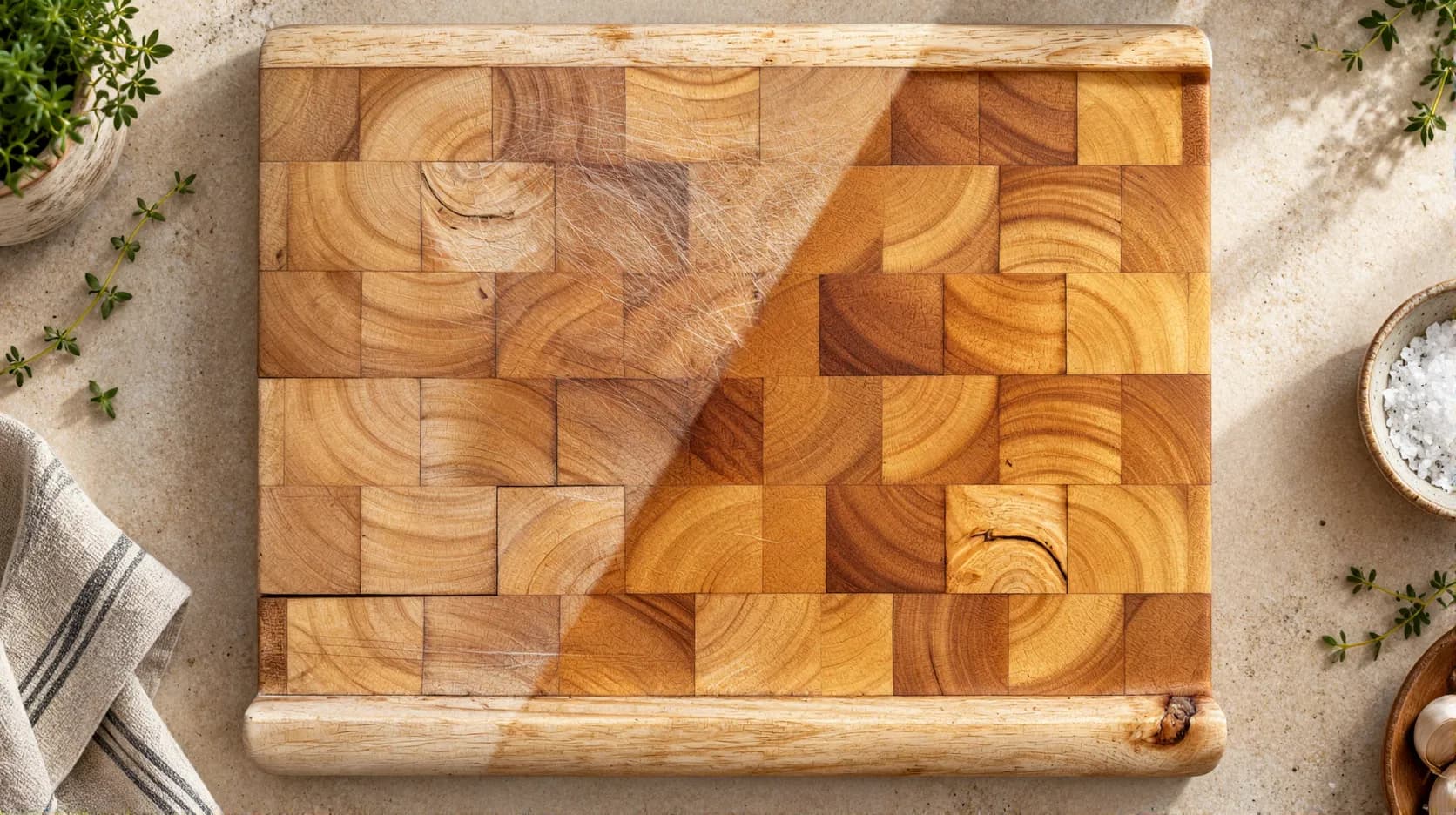
The Refresh Service is mail-in restoration for wooden chopping boards — ours or anyone’s. You post the board to the workshop near Selby; Ewald flattens it, resurfaces it, re-cuts the edges, deep-cleans it and finishes it in food-safe oil and wax. Then it comes home to you.
Free assessment · A fixed price before you commit · Nothing to pay until you accept
How it works
- 01
Send photographs
Three or four from your phone — the whole board, one along the surface in daylight, and a close-up of anything that worries you.
Two minutes - 02
We look, and price it
Ewald looks at every board himself and writes back with one fixed price. If it isn't worth the postage, he'll tell you that instead.
Free, no obligation - 03
You decide
Nothing is charged until you say yes. If you go ahead, the reply carries the workshop address and how to wrap the board.
No deadline - 04
It goes on the bench
Flattened, resurfaced, edges re-cut, deep-cleaned, then finished in food-safe oil and wax.
In the workshop - 05
It comes home
Wrapped and posted back to you. Return postage is inside the price you already agreed.
Postage included
What happens on the bench
Assess and clean. The board is checked over dry, then deep-cleaned — years of oil, food residue and grey surface grime come off before anything else happens.
Flatten. A board that has cupped or twisted is brought back flat, taking off only as much as the shape actually needs.
Resurface. Knife scoring, stains and dead fibre are planed and sanded away until fresh wood is showing and the grain reads clearly again.
Re-cut the edges. The edges are trued and eased so the board is comfortable to lift and pick up — the part that makes a restored board feel new rather than merely clean.
Oil and wax. Finished in Walrus Oil Cutting Board Oil and Wood Wax, the same food-safe finish every Timbermere board leaves with.
What we can renew — and what we’d turn away
- Solid hardwood boards of any age
- Boards we made, and boards we didn't
- Grey, dry, scored or stained surfaces
- Boards that have cupped or gone out of flat
- Inherited and second-hand boards
- Butcher's blocks, end-grain and edge-grain alike
- Bamboo — it is silica-loaded and destroys plane irons
- Laminate, composite and plastic boards
- Anything that isn't solid wood
- Boards already so thin that taking more off would leave them fragile
- Boards whose glue joints have failed right through
- Commercial and catering boards, which carry their own compliance rules
Not sure which yours is? That is exactly what the photographs are for — send them and we’ll tell you before you post anything.
Getting it here — and back
Posting a board you have had for twenty years to someone you have never met is the hard part of this, and we would rather say so than pretend otherwise.
Nothing is posted before it is priced. The photographs exist so that we can say no — or say “this one is not worth the postage” — while your board is still safely in your kitchen. Once you accept a quote, the reply carries the workshop address and how to wrap it.
While it is with us, it is our responsibility. Taking reasonable care of a board left in our hands is not a promise we invented for this page; it is what the law already requires of us, and we are not going to pretend it is a favour.
The journey home is on us. Return postage is inside the price you agreed, and because we are the ones sending it, the risk on that leg is ours rather than yours.
If it turns out to be beyond saving, we stop. Occasionally a board only shows what is really wrong once the grime is off it. If that happens, Ewald stops and writes to you before going any further, rather than carrying on and presenting you with the result.
Your right to change your mind
Because you’re arranging this at a distance, you have 14 days from agreeing the work in which to cancel, and you don’t have to give a reason. Replying to our email is enough — there is no form to find.
If you ask us to start straight away and we finish inside those 14 days, the right ends when the work is done — that is the trade for not waiting a fortnight before the board goes on the bench. If you cancel part-way through, you pay for the work already done and nothing more. We set all of this out again, in writing, in the quote we send you, so it is somewhere you can keep.
Separately, and whatever happens to that window: the work has to be done with reasonable care and skill. That is your statutory right and we cannot sign it away.
The full terms for this service — including what happens to a board we can’t return — are in our Terms of Sale.
What it costs,
and why.
Any solid timber welcome
The Refresh Servicefrom £45
Every board is different, so the figures above are a floor rather than a quote. You send photographs, Ewald looks at them, and you get one fixed price — for that board, before you commit to anything. Nothing is charged until you accept it, and if it turns out the board isn’t worth the postage, he’ll tell you that rather than take the work.
What moves the price: size and thickness, how far the surface has to come back, whether the board is far enough out of flat to need real flattening, and whether there’s a crack or a loose joint to deal with.
If it’s only tired rather than damaged, the care guide will get you most of the way there for the price of a bottle of oil. That’s not a sales pitch — it’s just true.
Is this the same as the guarantee? Two different things. If a piece we made goes wrong within 12 months, we put it right free under the workmanship guarantee. The Refresh Service is separate and paid: it restores any wooden board, including boards we didn't make and boards long out of guarantee.
No account, no deposit, nothing committed by sending it.
Questions
Can you restore an old wooden chopping board?
Usually, yes. A solid wooden board that has gone grey, scored, stained or slightly out of flat can be planed back to fresh wood, re-cut at the edges and re-finished in food-safe oil and wax. Age is not the problem — most boards that look finished are simply worn on the surface, and the surface is the part we can take back. Send photographs and we'll tell you honestly what yours needs.
How much does it cost to restore a wooden chopping board in the UK?
Every board is different, so there is no price list. You send photographs, we look at them, and you get one fixed price for your board before you commit to anything. What moves the price is size and thickness, how far the surface has to come back, whether the board needs real flattening rather than a light resurface, and whether there is a crack or a loose joint to deal with. Return postage is inside the price we quote.
Can a cracked wooden chopping board be repaired?
It depends which of three things you have. Fine surface checking — short hairline splits in the face — usually planes straight out. A glue line that has opened along a joint can often be cleaned out and re-glued, because it is a joint failing rather than the wood. A crack running through the grain, especially one you can see daylight through or that moves when you flex the board, is a different matter: it usually means the board is finished as a chopping surface, and we will say so rather than take the work.
Do you restore boards you didn't make?
Yes — that is most of what the service is for. Boards bought elsewhere, inherited boards, market finds and old butcher's blocks are all welcome, as long as they are solid wood. You do not need to know who made it, or what wood it is; we can see both when it arrives.
How do I send my chopping board to you?
Not yet — the photographs come first. Once you accept a quote we send you the workshop address and how to wrap the board, and only then do you post it. Please don't send a board before you have a quote: we can't take responsibility for a board that arrives unannounced, and if it turns out to be one we can't help with you'll have paid the postage for nothing.
Is it worth restoring a chopping board, or should I just buy a new one?
Sometimes the honest answer is that it isn't. If a board is thin, cracked through, or made of something we can't work, you would be better off replacing it, and we will tell you that rather than take the job. But if the board is sound and simply tired — grey, scored, dry — restoring it is usually the better call, and it keeps a board you already know out of the bin. If it is only tired rather than damaged, our care guide will get you most of the way there at home for the price of a bottle of oil.
How long does the restoration take?
We tell you when we quote, because it depends on the board and on what is already on the bench. The workshop is one person, so we would rather give you a real date for your board than publish an average that turns out to be wrong for it.
After a new board rather than a repair? The collection is here — and every piece we make is built to come back for this one day.